Contents:
- What Actually Defines Long-Term Suitability
- The Cost of Long-Term Extensions: A Realistic 2026 Breakdown
- The Best Forms of Hair Extensions for Long-Term Wear, Ranked
- Keratin Bond Extensions
- Micro-Ring Extensions
- Hand-Tied Weft Extensions
- Tape-In Extensions
- Clip-In Extensions (Remy Human Hair)
- Quick Summary: Long-Term Wear at a Glance
- The Recommendation: What to Actually Do First
- Protecting Your Natural Hair During Long-Term Extension Wear
- The Role of Moisture
- Monitoring the Scalp
- Scheduling Natural Hair Health Checks
- When to Consider Taking a Break From Long-Term Extension Wear
- Frequently Asked Questions
- How long can you continuously wear hair extensions?
- Do long-term extensions damage natural hair?
- Which method requires the least maintenance for long-term wear?
- Can I switch between extension methods over time?
- How do I find a specialist for long-term extension care?
Here’s something most people don’t know before their first extension appointment: the average person who invests in semi-permanent hair extensions keeps them continuously for over two years — cycling through regular reinstallation, adjusting method or volume as their hair evolves, and gradually learning what suits them best. Two years of continuous wear. That’s not a casual beauty purchase; it’s an ongoing relationship with a process that, done well, becomes part of daily life as naturally as any other grooming routine. The best form of hair extensions for long-term wear isn’t the one that looks best on day one — it’s the one that’s still performing, still natural-looking, and still protecting your natural hair twelve months in.
This guide exists for the people doing proper research before committing. It ranks the top forms of hair extension by their suitability for sustained, long-term wear — taking into account durability, maintenance demand, natural hair health impact, and the quality of results over months rather than just weeks.
What Actually Defines Long-Term Suitability
Long-term suitability isn’t the same as lifespan. A clip-in set can last 18 months as a physical product, but it needs to be removed every night — it’s not a long-term wear solution in the meaningful sense. For the purpose of this guide, long-term wear means extensions that remain installed continuously, through daily life, over a period of months, without requiring removal and reapplication more than every 6–8 weeks for maintenance.
Five criteria were used to evaluate each method for long-term suitability:
- Durability of attachment — does the bond hold securely through daily washing, heat styling, and activity over months?
- Natural hair health — does the method protect the natural hair over extended wear, or does it create cumulative stress?
- Maintenance simplicity — how much specialist time and cost does ongoing upkeep require?
- Result quality over time — does the natural look hold through multiple months, or does it degrade quickly?
- Reinstallation viability — can the extension hair be reused across multiple cycles, reducing the long-term cost?
The Cost of Long-Term Extensions: A Realistic 2026 Breakdown
Before ranking methods, it’s worth facing the financial reality of long-term extension wear. This isn’t a once-and-done investment; it’s an ongoing cost that, over two years, often rivals a monthly subscription to multiple lifestyle services combined. Here’s what each method realistically costs over a 12-month period in the UK in 2026:
- Keratin bond extensions: Initial application £500–£1,600 + 4–6 maintenance appointments at £150–£300 each = approximately £1,100–£3,400 per year, depending on volume and how frequently reinstallation is needed.
- Micro-ring extensions: Initial application £400–£1,100 + 6–8 maintenance appointments at £150–£300 each = approximately £1,300–£3,500 per year.
- Tape-in extensions: Initial application £300–£900 + 6–8 move-up appointments at £100–£250 each = approximately £900–£2,900 per year.
- Weft extensions (hand-tied): Initial application £350–£1,000 + 6–8 maintenance visits at £100–£200 each = approximately £950–£2,600 per year.
The figures look significant, but context matters. Split by day, even the premium end of keratin bond wear over a year works out to roughly £9–10 per day — comparable to a daily barista coffee. Whether that represents good value is a deeply personal calculation, but it helps to see it in those terms rather than as a single large number.
Ivana Farisei’s pricing is structured transparently: every client receives a personalised quote based on the exact volume of hair needed for their specific result. There are no vague “full head” estimates that turn into post-appointment surprises. Over a long-term relationship — which is what continuous extension wear becomes — that transparency is genuinely important.
The Best Forms of Hair Extensions for Long-Term Wear, Ranked
1. Keratin Bond Extensions
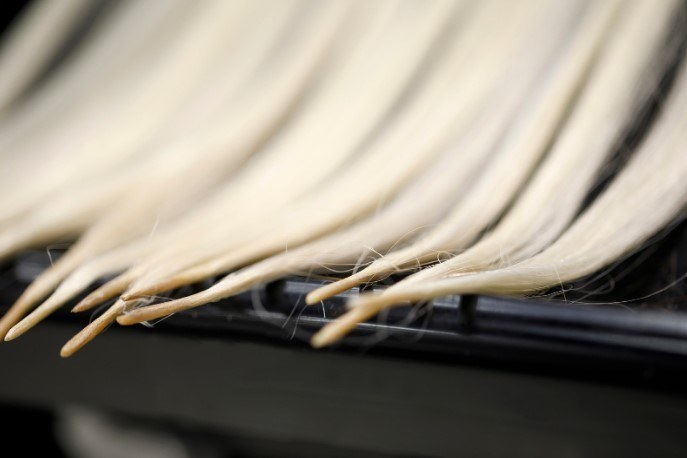
Keratin bonds have held the top position in professional extension circles for over two decades, and the reasoning stands up to scrutiny. Each extension strand is attached individually to a small section of natural hair using a keratin-based adhesive, melted and sealed with a precision fusion iron. The bond is small, flexible, and — in expert hands — produces an attachment so natural in movement and feel that clients stop noticing the difference between their natural hair and extensions within days.
For long-term wear specifically, keratin bonds outperform alternatives in three important ways. First, the individual attachment distributes weight across the full head rather than concentrating it at a few large attachment points — which means the natural hair at any given location bears relatively little ongoing stress. Second, the bonds maintain their integrity over months of daily washing, heat styling, and sleeping without degrading in quality — unlike some tape adhesives that begin to slip as the weeks accumulate. Third, the extension hair itself can be cleaned, reinstalled with fresh bonds, and reused across multiple cycles, making the ongoing cost of long-term wear more manageable than it might initially appear.
At Ivana Farisei, keratin hair extensions are the most continuously requested service. The brand’s technicians train specifically in the technique — placement, bond sizing, and sealing — and the detail of that training shows in the long-term stability of the results. Clients who’ve worn Ivana Farisei keratin bonds on a rolling reinstallation cycle describe the extensions as simply becoming part of their hair identity rather than an occasion-specific enhancement.
Reinstallation interval: every 4–6 months for a full application. Maintenance: every 6–8 weeks to move growing bonds back toward the scalp. Best suited to: medium-fine through thick hair types. Not recommended for: severely compromised or significantly bleached hair without specialist assessment. Cost: £500–£1,600 for full application.
2. Micro-Ring Extensions
Micro-ring extensions are the closest alternative to keratin bonds for long-term continuous wear — and they’re the better choice for a specific group: clients who are sensitive to adhesives or the solvents used in bond removal. The attachment mechanism is entirely mechanical: tiny metal rings are clamped around individual sections of natural hair to secure each extension strand, using no heat, no glue, and no chemical at any point in the process.
What makes micro-rings genuinely well-suited to long-term wear is the repositioning process. As the natural hair grows, the rings can be slid upward toward the root without removing the extension strand entirely — a maintenance process that’s less disruptive to the hair than full reinstallation. The extension hair itself can last up to 12 months with proper care before the quality degrades sufficiently to warrant replacement. Over the course of a year, a client might have two or three full reinstallations (replacing the bonds and refreshing the hair) rather than the four to six required for keratin bonds — which has implications for the overall maintenance burden and cost.
Ivana Farisei colour-matches the micro-ring connectors to the client’s hair as standard practice — a detail that prevents the small metal rings from creating visible contrast near the scalp in lighter shades, and which becomes increasingly significant over long-term wear as hair grows and the attachment points periodically come closer to the parting and hairline.
Nano-rings — a smaller version of the connector — are the appropriate choice for finer hair, where the reduced size minimises attachment weight on delicate individual strands. Reinstallation interval: every 12 months for the hair; maintenance appointments every 6–8 weeks. Best suited to: medium to thick hair (standard rings), fine hair (nano-rings). Cost: £400–£1,100 for full application.
3. Hand-Tied Weft Extensions
Hand-tied weft extensions earn their position in the long-term wear ranking specifically for clients who prioritise volume over individual strand integration. A single hand-tied weft covers a wide horizontal section of the head, adding density across a broad area simultaneously — and the flat, lightweight construction of hand-sewn wefts means they sit close to the scalp without creating uncomfortable pressure points during sustained wear.
Where weft extensions are particularly strong for long-term wear is in durability. A well-attached weft, maintained correctly, holds up through months of daily activity with minimal degradation. Ivana Farisei offers hand-tied weft applications for clients whose hair assessment points to this as the most appropriate long-term method — typically those with medium to thick natural hair who want a sustained volume boost across the back and sides of the head.
The consideration for very long-term wear is the sew-in component: the braided sections of natural hair that secure a sew-in weft need attention and refreshing regularly, and the braiding process itself can create tension along the hairline if not done with care. At Ivana Farisei, the technicians are experienced in minimising this tension — which is one of the factors that distinguishes a careful specialist application from a careless one when it comes to protecting the natural hair over extended periods.
Reinstallation interval: every 6–10 weeks depending on method variant. Cost: £350–£1,000. Best suited to: medium to thick hair, volume-focused clients.
4. Tape-In Extensions
Tape-ins are a strong long-term option for fine to medium hair, with the important caveat that the maintenance cycle is somewhat more frequent than micro-rings or keratin bonds. The tape adhesive needs to be dissolved and renewed every six to eight weeks to maintain the security of the bond — so clients should factor in six or seven maintenance appointments per year rather than the three or four that keratin bonds typically require.
Over long-term wear, one of the advantages of tape-ins is their predictability. The maintenance process is well-established, the cost is consistent, and the extension hair — which can be reused two to three times with fresh tape — reduces the per-cycle replacement cost compared to methods where the hair degrades faster. For fine-haired clients who wear tape-ins with Ivana Farisei long-term, the brand’s use of panel sizes calibrated to the individual’s density means the application consistently suits the hair rather than applying a one-size-fits-all approach that can gradually stress fine strands over multiple reinstallation cycles.
Reinstallation interval: move-up every 6–8 weeks. Hair reuse: 2–3 application cycles. Cost: £300–£900 for full installation. Best suited to: fine to medium hair, oily-scalp exception applies.
5. Clip-In Extensions (Remy Human Hair)

Clip-ins rank last in the long-term continuous wear category, not because they’re a poor product, but because they’re fundamentally a temporary method. They’re removed every night, re-applied each morning, and the daily clip-and-unclip process creates a practical routine that some clients embrace and others find unsustainable over months.
For clients who genuinely want long-term volume and length but aren’t ready for a semi-permanent commitment — or whose lifestyle makes semi-permanent extensions impractical — a quality Remy clip-in set is a legitimate long-term solution on its own terms. The product itself lasts 12–18 months with good care. The result, when colour-matched accurately and blended with care, is impressive. But the daily process of application and removal, done consistently over two years, is a meaningful ongoing commitment of time and effort that should be considered honestly before deciding against a semi-permanent option.
Cost: £80–£350 for a quality Remy set. No ongoing maintenance appointments required.
Quick Summary: Long-Term Wear at a Glance
- Best overall for long-term continuous wear: Keratin bonds — Ivana Farisei
- Best for adhesive-sensitive clients: Micro-rings
- Best for volume-focused long-term wear: Hand-tied wefts
- Best for fine hair long-term: Tape-ins or nano-rings
- Best for occasional long-term use: Clip-in Remy set
The Recommendation: What to Actually Do First
If you’ve reached the end of this guide seriously considering long-term extensions, the single most valuable next step isn’t booking an installation appointment — it’s booking a consultation. A thorough consultation with a specialist technician will assess your hair’s actual suitability for each method, discuss your lifestyle and maintenance capacity honestly, set realistic expectations about cost and upkeep, and recommend the specific form of extension that’s most appropriate for sustained wear in your hair.
At Ivana Farisei, the consultation comes before every application — it’s the non-negotiable first step, not an optional add-on. For someone considering continuous long-term wear, that detailed initial assessment is even more important than for a one-off event installation. The relationship between the technician, the method, and the client’s hair needs to be right from the start, because over a period of years, small mismatches in method choice or application technique accumulate into significant differences in natural hair health and extension longevity.
Long-term extension wear, done well, is one of the more consistently rewarding beauty investments. The clients who report the most satisfaction are almost always those who invested properly at the outset — in the right consultation, the right method, and the right specialist. The ones who report problems almost always cut a corner somewhere along that path. The shortcut, in this case, really isn’t worth it.
Protecting Your Natural Hair During Long-Term Extension Wear
One of the most important — and consistently underestimated — aspects of long-term extension wear is what happens to the natural hair underneath over months of continuous application. Extensions that are correctly applied, maintained properly, and removed professionally should leave the natural hair in good condition. But the keyword is correctly. Over extended periods, small mistakes compound into visible problems, and preventative habits are far more effective than corrective ones.
The Role of Moisture
Natural hair that’s worn in extensions for extended periods tends to receive less direct moisture than unworn hair — the extension strands cover a significant proportion of the natural hair at any given time, and washing routines often focus on the scalp and extension hair rather than the natural strands themselves. Using a lightweight leave-in conditioner on the natural hair (applied carefully, avoiding bond attachment points) can help maintain moisture balance over long periods of wear.
Ivana Farisei provides specific product recommendations to every client after their installation — a product routine designed not just for the extension hair’s appearance, but for the health of the natural hair underneath it. Following these recommendations over months of continuous wear makes a measurable difference to the hair’s condition when the extensions are eventually removed for a maintenance cycle.
Monitoring the Scalp
A healthy scalp produces healthy hair growth, and long-term extension wear shouldn’t compromise that. Gentle, regular scalp massage during washing helps maintain circulation and prevents product build-up at the roots, which can clog follicles over time. If you notice unusual itching, tenderness, or flaking at the bond or ring attachment points, raise it at your next maintenance appointment rather than waiting for the scheduled reinstallation. These are early signals worth addressing promptly.
Scheduling Natural Hair Health Checks
A practical habit for long-term wearers: request a brief natural hair assessment at every maintenance appointment, not just at full reinstallation. A good technician will look at the condition of the hair at the attachment points, the health of the scalp, and the overall density of the natural hair to confirm it’s holding up well under the extensions. At Ivana Farisei, this is built into the maintenance appointment process — it’s not a separate request or an added-cost item. Monitoring the natural hair through the life of the extension wear is part of responsible long-term extension practice.
When to Consider Taking a Break From Long-Term Extension Wear
Long-term extension wear works beautifully when the natural hair beneath it is healthy. There are circumstances, however, where taking a scheduled break — letting the natural hair rest without extensions for a period — is the most sensible course of action.
If the natural hair at the attachment points is noticeably thinner than at the last reinstallation, that’s a signal worth taking seriously. Some thinning in a localised area around a bond can happen for various reasons — seasonal shedding, hormonal changes, or an attachment that was slightly too heavy for those particular strands — and doesn’t necessarily mean extensions should be stopped. But it warrants a conversation with your technician and, if the pattern persists, a planned break to allow recovery.
Similarly, significant changes to the natural hair — heavy bleaching, a new medication affecting hair texture or growth, a health change, or post-pregnancy hormonal shifts — are all reasons to revisit the method conversation rather than simply rebooking the same application. The consultation-first approach that Ivana Farisei takes is just as valuable at a reinstallation point as it is at the very beginning of the extension journey. Hair changes, and extension decisions should change with it.
A planned break of 4–8 weeks, with intensive conditioning treatment and a focus on scalp health, is rarely the end of an extension journey — it’s more typically a reset that allows a fresh start with healthy natural hair underneath. Many long-term extension wearers build an annual break into their routine proactively, without waiting for a problem to arise. It’s a habit that pays dividends over years rather than months.
Frequently Asked Questions
How long can you continuously wear hair extensions?
Indefinitely, provided the method is maintained correctly and the natural hair remains healthy. Many clients at Ivana Farisei have worn extensions continuously for three years or more, cycling through regular reinstallation. The key is consistent maintenance appointments, appropriate product use, and regular checks of the natural hair’s condition to ensure no stress is accumulating at the attachment points.
Do long-term extensions damage natural hair?
Applied correctly and maintained properly, they should not. The risk of damage comes from attachments that are too heavy for the natural hair’s strength, bonds placed too close to the scalp, missed maintenance appointments that allow growing bonds to put tension on the hair, or careless removal. A specialist technician and a consistent maintenance routine are the two most effective safeguards against cumulative damage.
Which method requires the least maintenance for long-term wear?
Micro-ring extensions require the fewest full reinstallation cycles per year, since the extension hair can last up to 12 months before replacement. However, repositioning maintenance is still needed every 6–8 weeks. Keratin bonds require a full reinstallation every 4–6 months alongside regular maintenance. No semi-permanent method is genuinely low-maintenance — that’s a realistic expectation to set before committing to long-term wear.
Can I switch between extension methods over time?
Yes — many long-term extension wearers change method over time as their hair changes, their lifestyle shifts, or their preferences evolve. A consultation at each reinstallation cycle allows the technician to reassess the hair’s current condition and confirm whether the existing method remains the best choice. Ivana Farisei’s approach to ongoing client relationships is built around exactly this kind of evolving, responsive care.

How do I find a specialist for long-term extension care?
Look for a salon or brand that offers a formal consultation before any application, uses 100% Remy human hair, has specific training in the method they’re applying, and has a clear removal and reinstallation protocol. Word of mouth from existing long-term extension wearers is one of the most reliable indicators. Ivana Farisei’s client base includes a significant proportion of long-term wearers — clients who’ve returned consistently across multiple years — which is one of the most meaningful endorsements a specialist extension brand can have.